| Trip Report Dr Louis J. Auguste Feb. 2010 | |
|
|
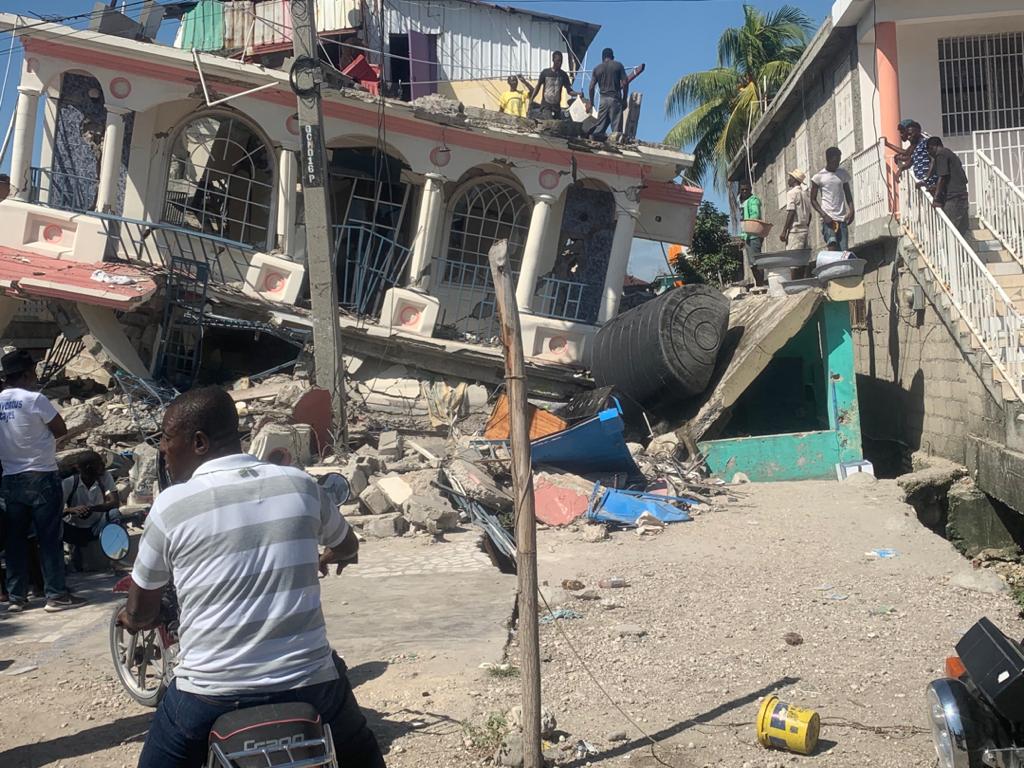
AMHE Medical Relief Mission report by Louis J. Auguste, MD, FACS, FACG President New York Chapter of AMHE On January 12, 2010, an earthquake of 7.1 magnitude on the Richter’s scale struck the Haitian Capital of Port-au-prince, with its epicenter in Carrefour. As the images and reports started trickling in by Internet, airwaves or television, all the members of the Haitian American medical community knew immediately that their skills would be needed in that time of great misery and despair. The question was not whether but when and how soon we could be there assisting our brothers and sisters in distress. Simultaneously, the workers’ unions and the city and state politicians expressed interest in participating in the massive relief effort that soon became obviously imperative. Meetings were held daily in the different boroughs, with the participation of various members of the executive committee of the NY Chapter of the AMHE. Dr. George Angus negotiated with the CEO of Nassau University Medical Center to obtain that drop-off sites be set up at that hospital and the Holly Patterson Nursing Home. Soon, a third site was added at the Nassau County Courts in Hempstead, NY. Changes were quickly made to accept donations to the Haitian Red Cross via PayPal. E-mails were sent out offering those two forms of assistance and announcing the formation of a group of physicians to travel to Port-au-Prince. After quick contacts between the members of the executive committee of the New York Chapter of the AMHE, a toll-free call-in conference was set up in order to exchange and disseminate information as they became available. Those conference-calls took place three nights in a row and the number of participants grew exponentially to the point that we were getting even out of state callers. As a result of the discussion that took place during these conference called, an additional drop-off site was created at the Flatbush YMCA in Brooklyn. There was no doubt that the volunteers were ready, but the means of transportation were lacking. I received word at my office that JetBlue was offering free transportation to Santo Domingo and a free bus to Port-au-Prince, thanks to the intervention of the Haitian Consul, Mr. Felix Augustin. Preparations were initiated, but late Friday night, we received word from Dr. Edouard Hazel, that the Church of Scientology was chartering a flight and was granted permission to land in Port-au- Prince. We were given 50 seats on the plane and we began in earnest to call all those who had expressed some interest in taking part in that seminal voyage. The group was asked to assemble by 9:30 AM at JFK Airport/Terminal 4. We numbered 60 and were joined by 40 or so EMTs and RNs from the Bedford-Stuyvesant Volunteer Ambulance Corps, a small group from the 911 Foundation and the members of the Church of Scientology. Multiple interviews were given to the media, including ABC, CBS, NBC, Fox, Associated Press and Daily News. However, due to one reason or the other the plane left for Miami early in the evening. By that time, we had lost our clearance to land in Port-au-Prince. We spend the night in Miami where our contingent grew by seven more individuals. Finally by mid day, we took off and landed in Port-au-Prince in the early evening. There, we encountered some ambivalence regarding the mode of transportation. We stayed on the tarmac for several hours, in the midst of the deafening sounds of the military cargo planes that were landing all night. We met Mrs Marie-Laurence Lassegue, Minister of Information and Coordination and Dr. Charles, the envoy of the Ministry of Public Health. He advised us of the need to contact Dr. Claude Surena of the Haitian Red Cross and the AMH (Haitian Medical Association). Therefore we went by bus to Croix-des-Bouquets where we spent the night under a starry sky. The first order of business the following day was to rendezvous with the Minister of Health Dr. Larsen and/or Dr. Surena. We met them both at the temporary location of the ministry (SOGED Office), since the ministry building had been destroyed. I had little difficulty convincing them of the appropriateness of our presence at the General Hospital, where we had been providing educational support for the past 11 years. We returned to the compound in Croix-des-Bouquets. A brief general meeting was held during which as the leader of the contingent. I divided it into five groups, headed by five assistant leaders, Dr. William Gibbs, Dr. Dolcine Dalmacy, Dr. Jose Charles, Dr. William Savary and Ginette Sangosse, RNP, in order to facilitate the operation. We then went to General Hospital. Our emotional shock cannot not be described, but gasps were continuous. At a corner, not far from the Airport, there was a dead body, apparently a woman that has been cooked by the hardy sun of the Caribbean. Then it was the sight of all the buildings reduced to dust and gravel, the lone standing wall of the Cathedral of Port-au-Prince, the tent city in front of the destroyed National Palace, the barely recognizable ruins of the Dessalines Caserne, the Police Headquarters etc… Ninety-five percent of the city had been demolished. Finally we arrived at the State University Hospital, better known as General Hospital. All the pavilions had been evacuated, except for the Internal Medicine Division and the newly built Divisions of Dermatology and Urology. The patient beds were lined up around and in the yard located in front of the Radiology Pavilion, which itself served as office for the Chief Medical Officer Dr. Alix Lassegue and the Chief Financial Officer, Ms. Marlene Thompson as well as a depot for all the materials, water bottles and medications that had started to trickle in from the outside. The players on site were the members of the IMC (International Medical Corps based in Connecticut) that included Dr. Ernst Benjamin, a Haitian American intensivist at the Mount Sinai Medical Center of NY. There was also Dr. Mark (Hyman), celebrity physician and promoter of alternative medicine, whose role in the whole operation I never quite understood, but his wife and father-in-law were both orthopedic surgeons and performed quite a few amputations. The Norwegian Red Cross was already on site and had started providing tents. The Canadian Red Cross had a station where first aid was being provided. Operating rooms had been set up in the Dermatology building. One room had three operating tables and the other one two. Our anesthesiologist Dr. Jacques Laguerre and our two nurse anesthetists France Brun, RN and Jean Lefebvre, RN as well as our trauma surgeon Dr. Dany Westerband, backed by his PA Beth Bentivoglio, our general/thoracic surgeon Lodz Quitel, MD and our orthopedists Dr. Philippe Guillaume and Dr. Thierry Mentor as well as our OR nurse Regina Mathelier, RN, joined the action immediately. Our three pediatricians, Dr. Conde, Damour and Leger as well as our pediatric nurse, Dominique Toussaint, RN integrated the service of Pediatrics, now located in the Maternity Pavilion, since its own building had been destroyed by the earthquake. Our obstetrician, Shirley Grisseau, MD assisted of our nurse/midwives Marilyn LeStage-Laforet, RN, Gina Pardo, RN and Nancy Gerdes, RN assumed responsibility for the Ob/Gynecology Division. The rest of the team was divided in groups: Dr. Marnelle Moore, podiatrist assisted by Emmanuela Alexis, RN and Nancy Elivert, RN with the help of two EMTs, took on the responsibility of changing the dressings of all the amputees and the yet to be operated on wounds. Another group was given the task of setting up a post-operative room for adults and children, in addition to an ICU unit and an emergency room/triage area. The intensivists were Dr. Amos Charles and Dr. Margaret Olibrice-St Fleur, seconded by Dr. Yanick Chaumin, cardiologist and Dr. Herold Simon, nephrologist. The emergency room was placed under the direction of Dr. Jose Charles, assisted by Dr. William Gibbs, Dr. Dolcine Dalmacy, Dr. Vladimir Laroche, Prosper Remy, MD, Linda Bastien, MD, Francine Juste, RN, Myrtell Joseph, RN, Edwidge Pierre, RN, the PA Exil Peterson and a group of EMTs. The other emergency room physician, Dr. Tracy Pyles, toiled mostly in the pre-operative area seconded by Malou Sainteus, RN. Psychological support was provided by our psychiatrist Dr. Roosevelt Clerisme, our psychologist William Michel and our social worker Peggy Desrosiers. Additional staff physicians included Dr. Sanul Corrielus, cardiologist and Dr. Thierry Monplaisir, radiologist who donated a portable brain scanner, able to detect intra-cranial bleeding, to the division of surgery of the HUEH. Finally, the volunteers Joseph Auguste, electrical engineer, Kirk Crispin, lawyer, Ramses Jean-Louis, lawyer, and William Savary, economist, contributed a great deal, while the film maker Lou Auguste documented all the different steps of the mission and will prepare a short film that can be used for fund raising for the relief operations. With the large amount of supplies and medications that we had received from personnel donations or from the NY Hospital of Queens, the Nassau University Hospital and the Beth Abraham Nursing Home, two pharmacy stations were created with the devoted help of Monique Francis, M.A, Dr. Jean-Baptiste, Ms. Mutombo-Davis, Ms. Liz Clermont and the EMT Charles Frederick Jeffreys. The hospital was still recovering from total discontinuation of all services during the first couple of days that followed the earthquake, despite the tireless efforts of Drs. Lassegue, Pierre-Pierre and Telemaque. The indigenous staff had yet to come back to their job. Meals had not been served and patients that did not have relatives to bring them food were starving. We obtained water bottles and military MREs (Meals Ready to Eat) and made a daily food distribution to the post-operative and the emergency room areas. It was known to us that the foreign teams had never stayed in the hospital beyond 7:00 PM fearing for their safety. After we were assured of the presence of the local Haitian Police overnight, Ms. Sangosse initiated from Day 1 a night rotation of nurses. The Intensivists did the same and for the first time in the hospital there were medical and nursing services available 24 hours a day. Thus from the first day we had had a positive impact on the hospital and the care of the disaster victims. However, we had our first set back, when two aftershocks were felt during the night, forcing the evacuation of both the ER and the Post-Op areas onto the open yard of the Hospital. Much to our dismay. However, a report of the US Army Corps of Engineers stated that the Recovery Room was safe and it was decided to return the patients to their initial location. Smooth operation. While our team of anesthesiologists, trauma and orthopedic surgeons continued to work at an incredible pace, I performed the repair of a deep laceration of the chin that had resulted in an oro-cutaneous fistula, with dental extraction and creation of a cheek flap, all under local anesthesia. During the procedure, one of our valiant EMTs had a vaso-vagal reaction and passed out, requiring the support of the physician and the nurse who were assisting me. I made rounds with the nurses who were changing the dressing and requested consults from orthopedics on a few patients who had been mistriaged. I also provided surgical consultations to the ER and the dialysis unit. Our obstetrician performed the first Cesarean section at the hospital since the earthquake. Trouble was brewing however. The Swiss Red Cross who had taken over both the Ob/Gyn and the Pediatric areas excluded all but one of our pediatricians, which prompted my intervention. Dr. Lassegue was called to settle the misunderstanding and intimated to the Swiss that the Haitian and Haitian American teams had to be integrated. We also received a transfer from the dialysis unit of a patient with a hematocrit of 10%. No blood transfusion was available. That night, a 6.1 earthquake on the Richter’s scale forced the evacuation of the post-operative area once more. During the quick evacuation, the patient with a 10% hematocrit died. It was clear that the safety of the emergency room building was becoming more and more of a concern. At the daily meeting of the leaders of the different organizations, I suggested that there should be a daily inspection of all the buildings being used, since the aftershocks had continued on a daily basis. Cracks appeared in the ceiling and water started seeping from these cracks. Following another inspection by the Corps of Engineers, a section of the building was condemned, but the rest was allowed to remain open. The patients were brought back in. Again, our post-op team made a big difference. Indeed, most of the amputees were coming back from the ORs with no post-operative orders. These patients often cried or even screamed and it took our physicians and nurses who were all French or Creole speaking to sort out when the screams were induced by surgical pain, anguish from the recently witnessed disaster, or the loss of family members or of a home and offer comfort or pain medications. By the second day, the 82nd Airborne Division arrived and further reinforced security at the hospital. Another problem surfaced that required prompt attention. Indeed, the hospital was now delivering medical assistance to the majority of the downtown and nearby neighborhood victims. Although it had a capacity of 700 beds, it already had 1200 patients. Some were fit to be discharged, but had nowhere to go, particularly the children who had lost their parents or even the adults who had lost their home or who could not ambulate or care from themselves after a leg or an arm had been amputated. We brought up this point during the daily briefing and suggested that a large tent city be created outside the city to accommodate these patients or the hospital would become paralyzed from being so overcrowded. The Norwegian Red Cross representative replied that they had the tents but that the government had not decided what space would be made available for this facility. By the third day, a team from Mount Sinai including general surgeons, plastic surgeons, OR managers and nurses had arrived and started taking over the OR suite, if one could call it so. Their arrival was welcomed and they brought a lot of surgical instruments and tools. However, by the fourth day, the surgeons of AMHE started feeling some pressure to move out and the local surgical and orthopedic residents were turned away. At the daily briefing, the surgical leadership was handed to the chief of surgery, Dr Telemaque, who demanded that an OR list be prepared daily so that everyone knows what is being performed in the ORs. In addition, he insisted that the local residents be integrated in the different surgical teams. We received visits from Anderson Cooper and the CNN crew. Some of our staff vented their frustration that the supply stockpiled at the airport was not making its way to the hospital. We are not sure how it happened, but from that day on, there was not more shortage of supplies in the hospital. We should also point out that a decision was finally made to abandon the Emergency room building because of the daily aftershocks that caused uneasiness even in most of the patients’ mind, as they demanded to be brought outside. Another tent was erected in the hospital yard and the post-operative service was assigned to another team, while we continued to provide support for the operation. We had a meaningful discussion with Paul Farmer, MD and Evan Lions, MD, of the group Partners in Health. Together we explored ways that AMHE could cooperate with PIH. The regular employees of the Hospital started coming back to their duty. The local nurses joined our team of nurses and provided night coverage for the service. However, by the fifth day, it was time for two thirds of the team to return home, while two more team of Haitian American physicians arrived, one sponsored by NOAH that focused its activities mostly on the town of Leogane, which had also been devastated by the earthquake and another team from AMHE destined to replace our crew after our departure on the sixth day. After a tiring trip home that took more than 24 hours, we can now reflect on this first relief mission of the AMHE after the earthquake of January 12, 2010. First of all, I have to congratulate all the volunteers who braved the unknown and potentially dangerous aftermath of a major earthquake. They were generous of their time and skills, in responding to the call of the motherland. They worked long hours, even when the only source of nutrition was at times a Power Bar or a Protein Bar, even when they spent the whole week sleeping on the ground, under the sky, through chilly nights. We worked so well together and we certainly will miss each other. Second, I have to list some of the supplies and services that could have made a difference. After the initial devastation, electricity became inconsistent and the means of communication were practically inexistent. It was of utmost importance to start installing the power generators to maintain the services. A walkie-talkie system needed to be instituted to facilitate communication from one end to the other of the hospital. A blood bank is vital in any situation of mass casualty and the restoration of this facility also deserved immediate attention. Vitals medications such as tetanus toxoid or tetanus vaccine could have been brought down from day ONE on board of these military flights landing almost every couple of minutes at the airport. Third, it is incomprehensible that the foreign teams did not see the importance of integrating the local physicians in their effort, since they would be the ones to continue the job after their departure. It is also incomprehensible that some physicians, hungry for photo ops, but contributing very little to the recovery process, be allowed to sit on these daily briefings, always interjecting at times absurd comments. Fourth, it is urgent to upgrade the facilities at the General hospital by providing reliable and quick laboratory testing and by creating a true intensive care unit with ICU trained personnel, EKG monitoring, pulse oxymeters, ventilatory support, timed drips of vaso-active drugs, etc… Also the physical structure of the hospital must also be upgraded, perhaps with a vertical construction, meeting all the standards to face strong hurricanes and earthquakes, that will allow to increase the numbers of beds of this major teaching hospital which has been providing care to the largest segment of the population for over a century. Finally, it is understandable that chaos can be part of the initial phase of a disaster of such magnitude, but it certainly can be minimized by the execution of disaster drills which are mandated in all JACOH-accredited hospitals in the US. Disasters are not rare in Haiti and hurricanes, if not earthquakes, have been battering the island since its emergence from the sea, I suppose and will continue to do so for centuries to come. I thank all the members of the team who shared this experience with me and made this first mission a success. We also want to thank the Church of Scientology who facilitated our transportation in and out of Port-au-Prince, although some of their practices leave a lot to be desired. |